
Gluing, welding or mechanical fastening: three ways to join plastic parts
Plastic components are by no means always made from a single piece. Often, several parts are joined together to form a complete product: a machine cover, a drip tray or an entirely different structure. Various techniques are available for this purpose, each with its own strengths and limitations.
At Lakwijk, we primarily use three joining techniques: gluing, welding and mechanical fastening. Which method is most suitable does not depend on preference, but on the application. Does the component need to be watertight? Does it need to be transparent? Or does the joint primarily need to be able to withstand high loads?
Gluing for aesthetically pleasing and rapid joints
Gluing is mainly used for transparent plastics such as polycarbonate and acrylic, for example in machine covers that are visible. Two components are placed against each other, after which a bead of adhesive is applied to the joint, which flows between the sheets by capillary action.
The main advantage of gluing is its speed and appearance. No additional finishing is required and the joint is barely visible. Gluing is therefore primarily chosen when aesthetics are important, and less so when sheer strength is the deciding factor.
Welding for strong and watertight joints
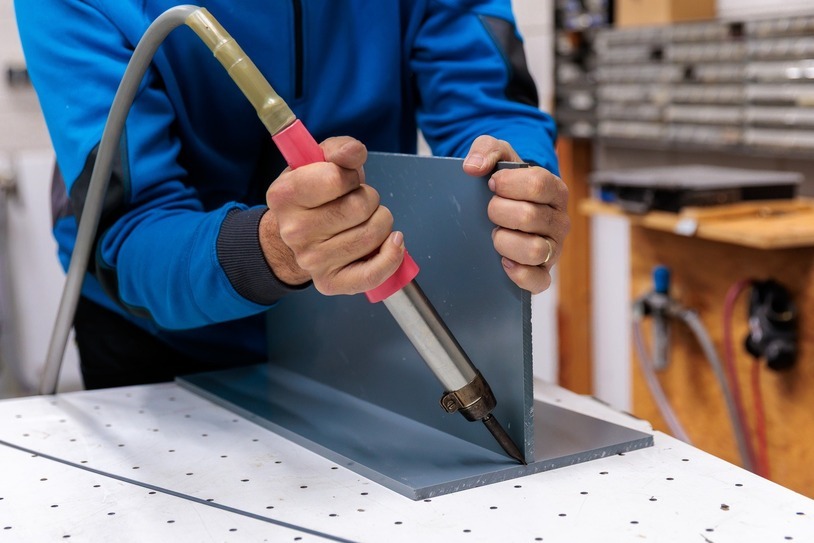
In welding, two plastic components are fused together using heat and a welding wire made of the same material. This creates a joint that is stronger and more watertight than a glued joint.
Welding is mainly used for opaque engineering plastics such as HDPE and PP, and is the logical choice when a component needs to be resistant to water or chemicals. A common application is the drip tray: components that are designed to collect liquids and therefore often come into contact with corrosive substances.
Mechanical fastening for added security
As well as gluing and welding, a joint can also be created mechanically, for example using bolts. This is often done to supplement gluing or welding, to further reinforce a joint. It is also a useful solution when gluing or welding is not practically feasible, such as with narrow edges that lack sufficient leverage for joining.
In practice, a combination of techniques is more common than a single method: a welded seam with additional mechanical fastening, or a bonded joint that is mechanically secured for extra strength.
A comparison of three joining techniques
| Technique | Key properties | Typical applications |
|---|---|---|
| Gluing | Fast, aesthetically pleasing, suitable for transparent applications | Machine covers, visible components |
| Welding | Strong, watertight, chemically resistant | Drip trays, tank construction. HDPE/PP components |
| Mechanical engineering | Flexible, easy to combine | Reinforcement, difficult edges, structural joints |
The choice always depends on your application
In practice, no two choices are exactly the same. The correct joining technique depends on the material, the function of the component and the conditions in which it is used, such as exposure to moisture, chemicals or UV light.
Are you unsure which joining technique is best suited to your plastic component? Lakwijk would be happy to discuss the application with you and then advise you on the most suitable joining method. Please get in touch for bespoke advice.


